Metric Type Definitions
Guandata Metric Center currently supports the following metric types:
| Metric Category | Description |
|---|---|
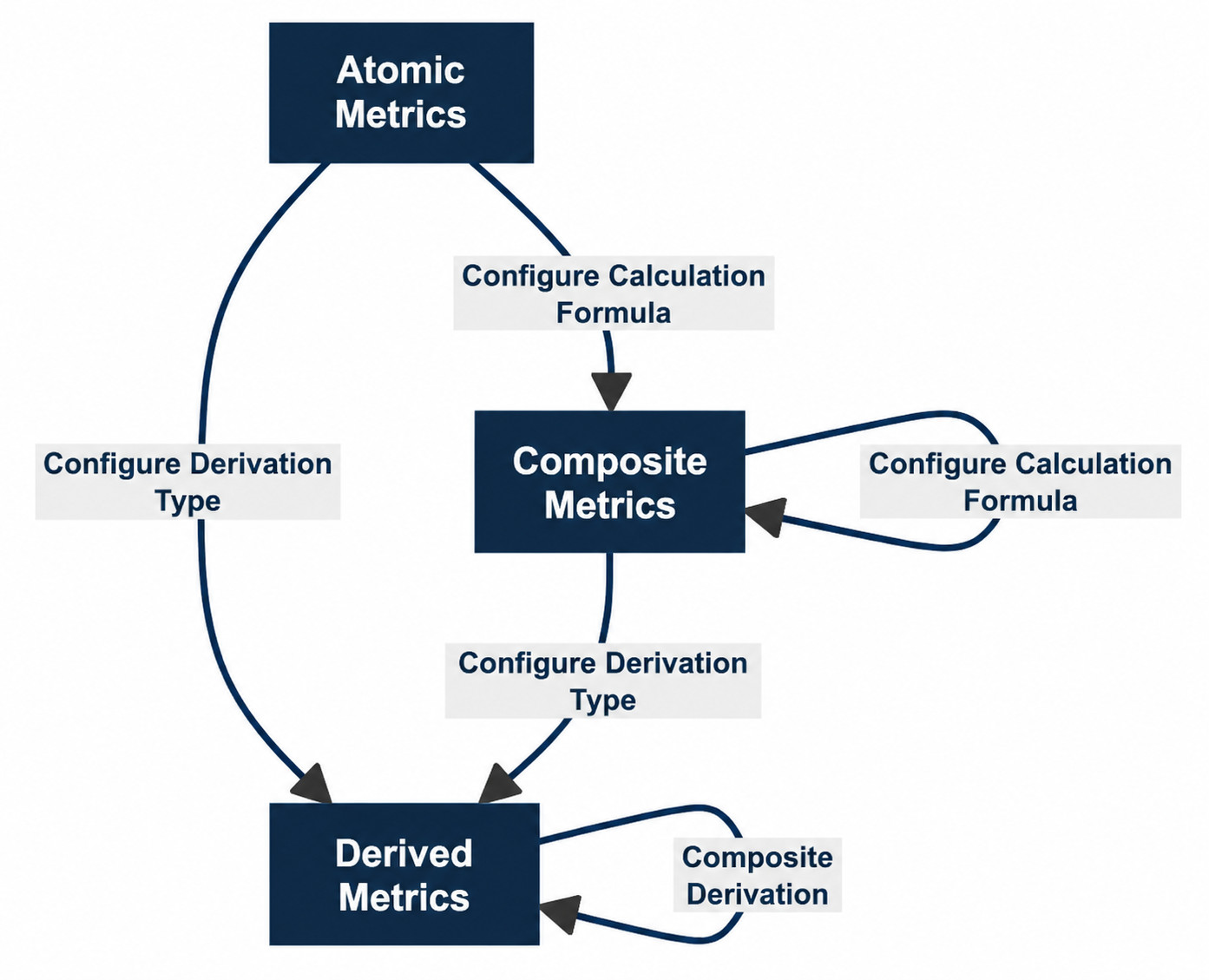
| Atomic Metric | A measure based on a specific business event behavior, which is an indivisible metric in business definitions. For example, Net Profit = sum(Order Net Profit), Total Transactions = count(distinct Order No). |
| Composite Metric | Calculated around multiple metrics (atomic metrics, composite metrics) through operations such as addition, subtraction, multiplication, and division. For example, Channel A Sales Proportion = Channel A Sales / (Channel A Sales + Channel B Sales) or Channel A Sales / Total Sales. |
| Derived Metric | Derived metrics are created based on a single atomic or composite metric, and extended with derivation methods such as cumulative calculation and YoY/MoM to expand analysis. For example, Net Profit YoY, cumulative value for recent N days based on Net Profit. |
The relationship between the three is shown in the figure below:
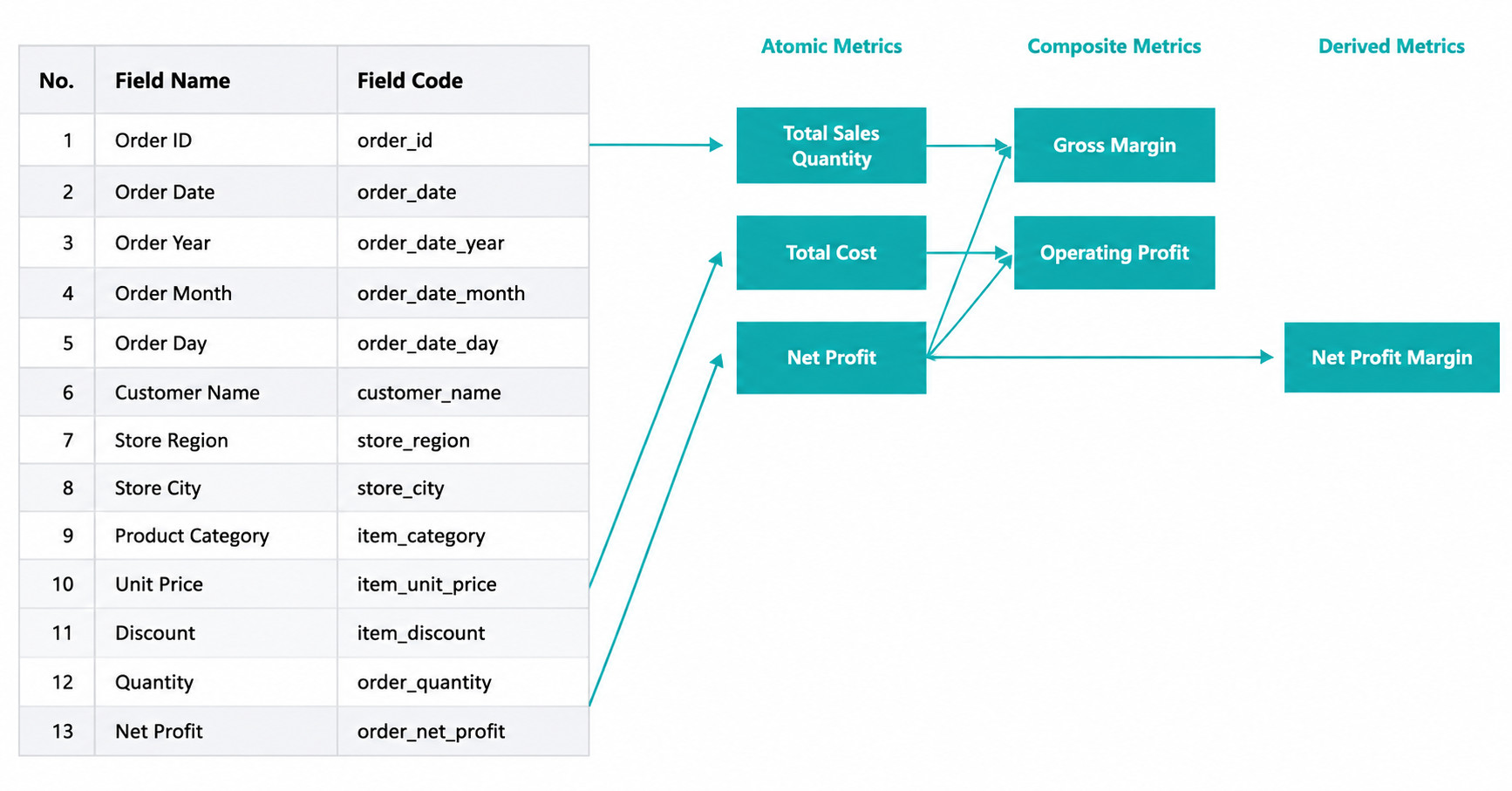
Taking the retail scenario as an example, the following is a retail transaction table. Based on fields such as order ID, order quantity, and order net profit in the table, metrics about transaction performance can be created, and order date, store region, store city, etc. can be used as analysis dimensions for metrics.
For detailed processes of creating atomic metrics, composite metrics, and derived metrics, see: