Card Detail Page Filter
Overview
When filtering Card data, in addition to filtering via Filter linkage, users can also filter individual Card data through the "Filter" feature on the Card detail page. Guandata BI supports configuring three types of filter conditions for the Filter:
- Field Filter: Filter a single field. For example, when performing sales analysis, if a user only wants to view sales records for the "East China" region, they can use the field filter feature, select the "Region" field, and choose "East China" from its dropdown menu to filter the sales data for that region.
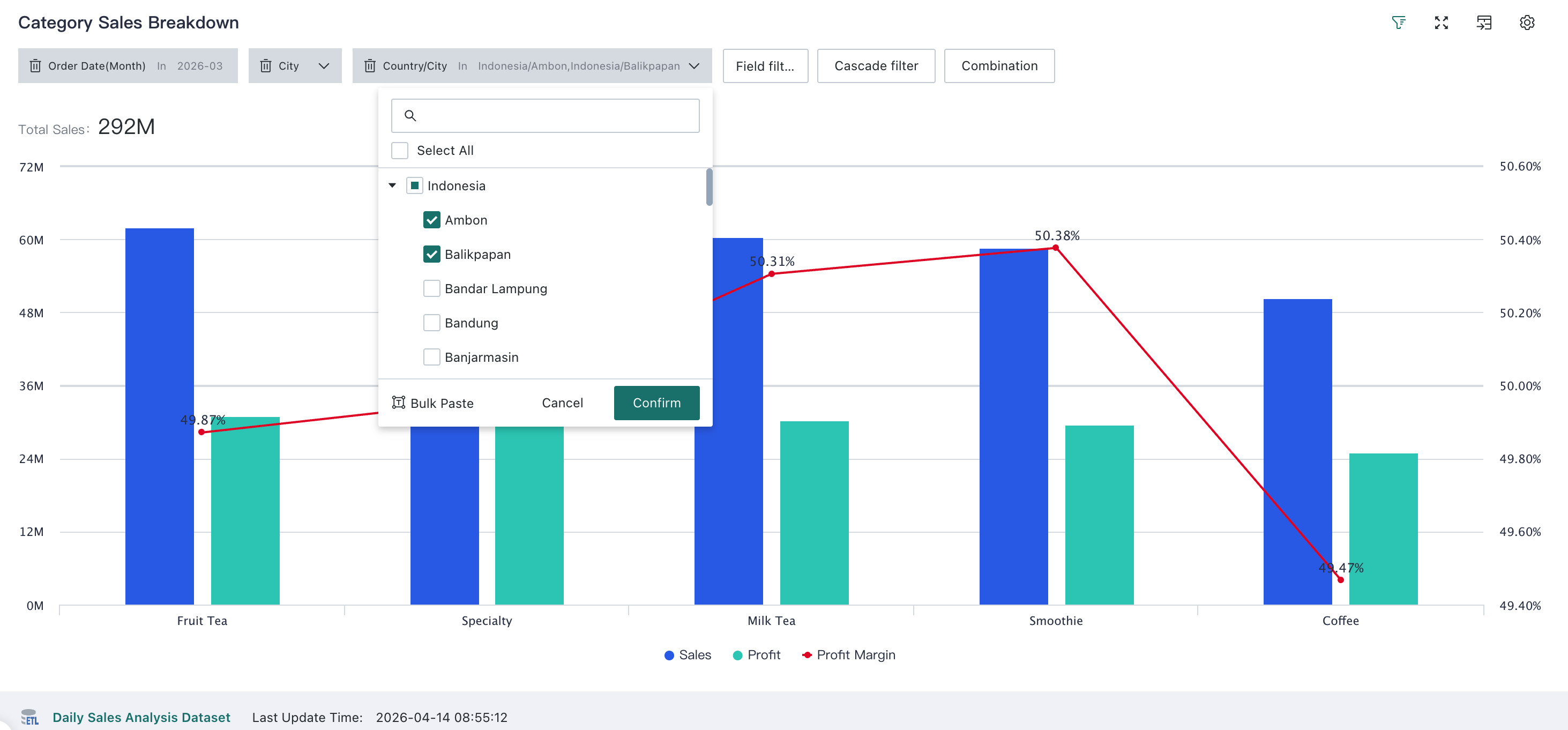
- Cascading Filter: Filter multiple fields simultaneously. For example, when performing sales analysis, if a user only wants to view sales data for "Chengdu, Sichuan Province", they can use the cascading filter feature. First select the "Province" field, then select the "City" field, and by progressively selecting "Province - Sichuan Province", then "City - Chengdu" under Sichuan Province, the sales data for "Chengdu, Sichuan Province" can be filtered.
- Combined Conditions: Supports setting "AND" and "OR" logical relationships for filter conditions, suitable for more complex analysis scenarios. For example, if a user wants to view sales records where sales amount exceeds 1 million AND profit margin is higher than 20%, they can add a combined condition with an "AND" logical relationship, setting the filter condition for the "Sales Amount" field to "Greater than 1 million" and the "Profit Margin" field to "Greater than 20%", to filter records where "sales amount exceeds 1 million and profit margin is higher than 20%".
- Supports adding multiple filter conditions of the same type simultaneously.
- Supports mixing different types of filter conditions.
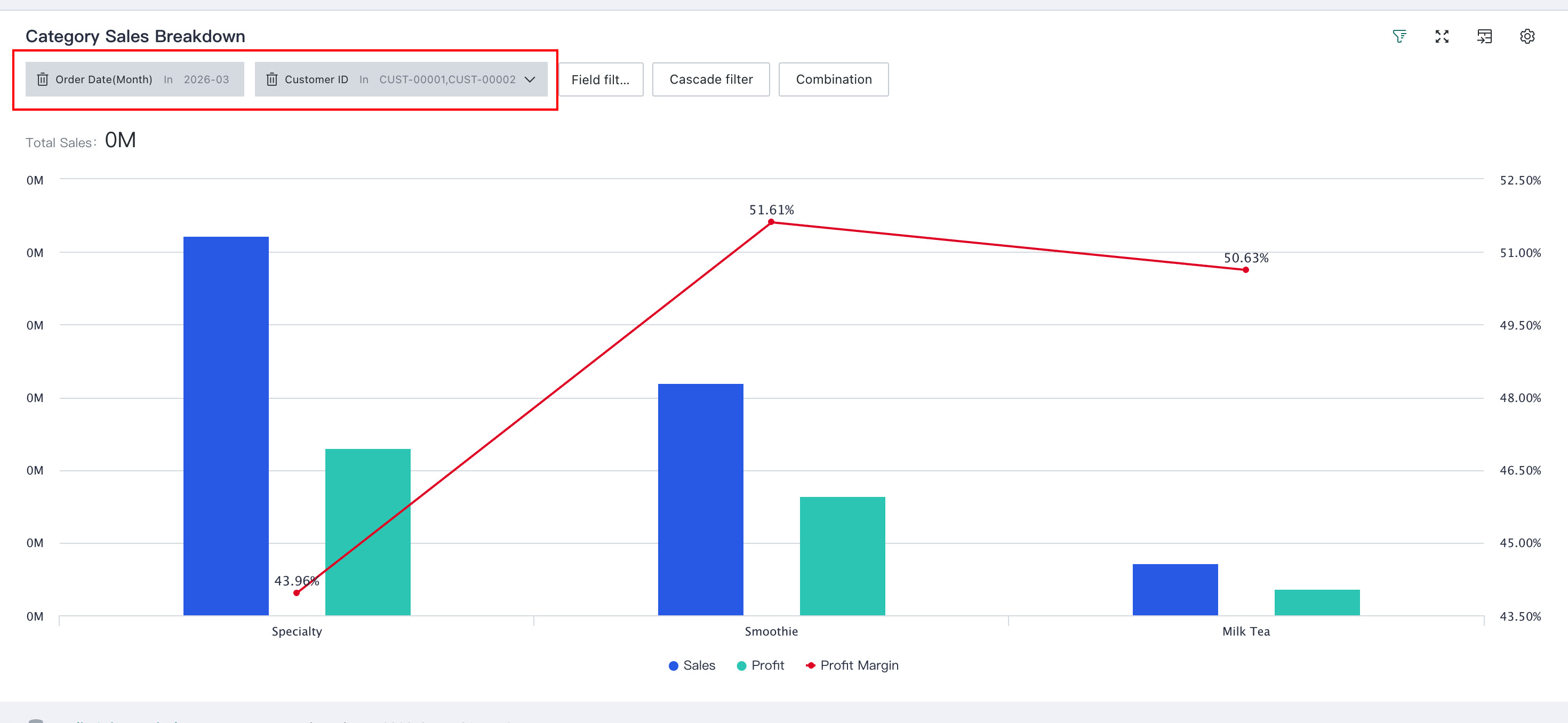
The "Filter" feature is suitable for filtering individual Card data, helping users quickly extract and analyze key information from large amounts of data. When entering from the page, the relationship between page Filters and fields will be automatically filled as the detail page filter, but there is no "Filter" concept on the detail page, so the filtering here is essentially conditional filtering on Dataset fields.
User Guide
Go to Detail
-
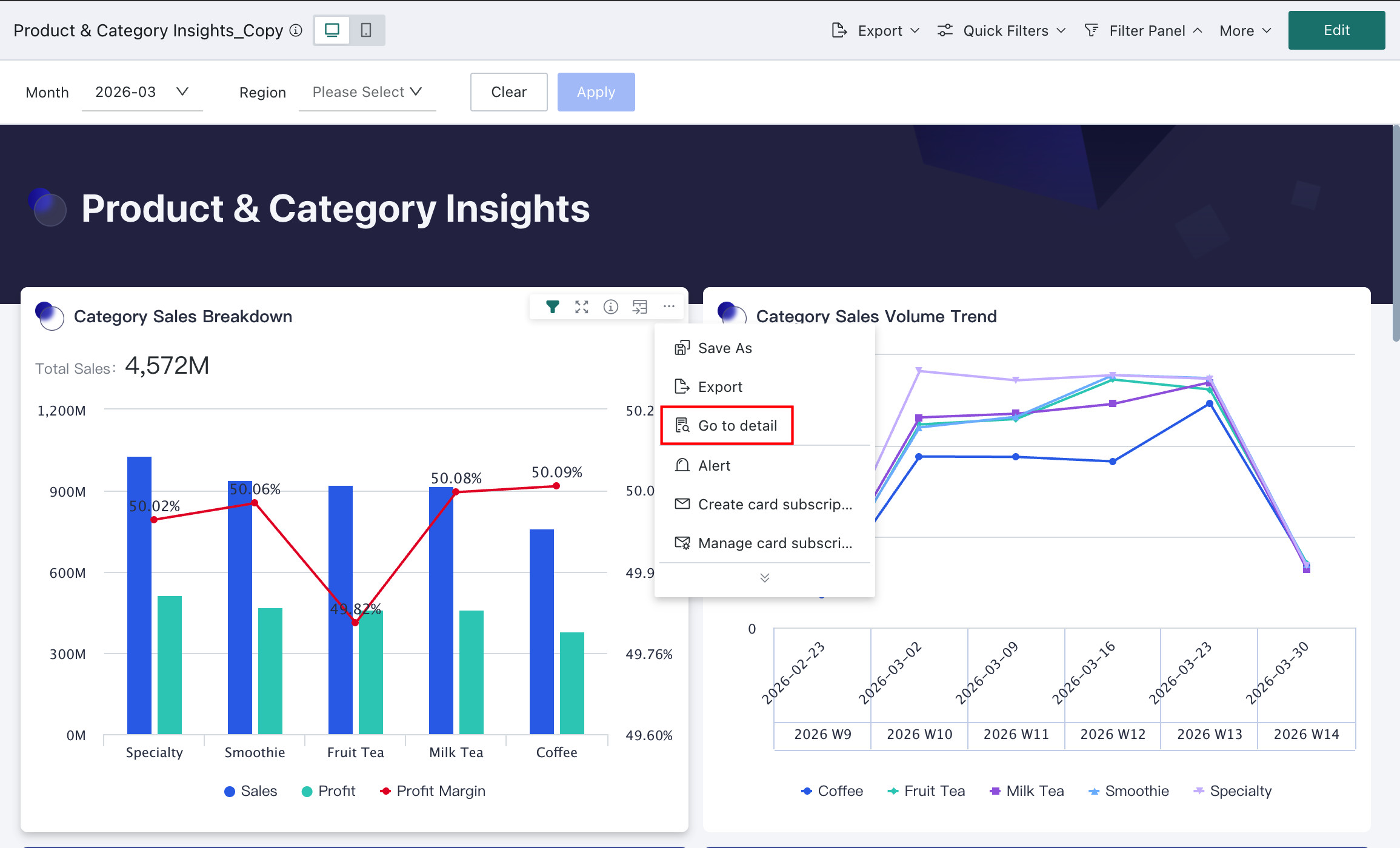
Before using the Filter, users need to click the "Go to Detail" button in the upper-right corner of the Card on the Dashboard page to enter the Card's detail view interface, where the Filter can be configured.
-
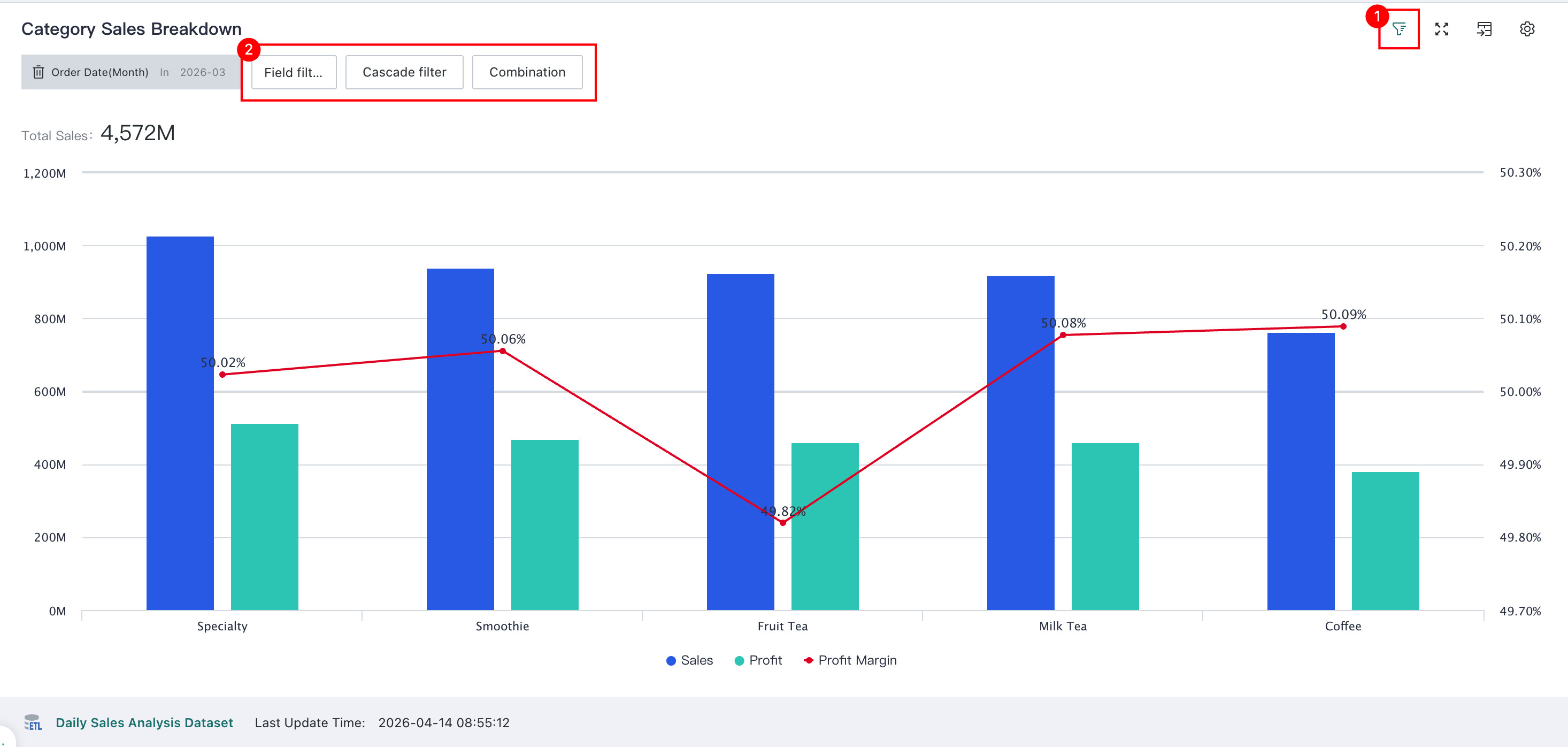
Click the "Filter" button in the upper-right corner to start using the Card Filter, including field filter, cascading filter, and combined conditions.
Field Filter
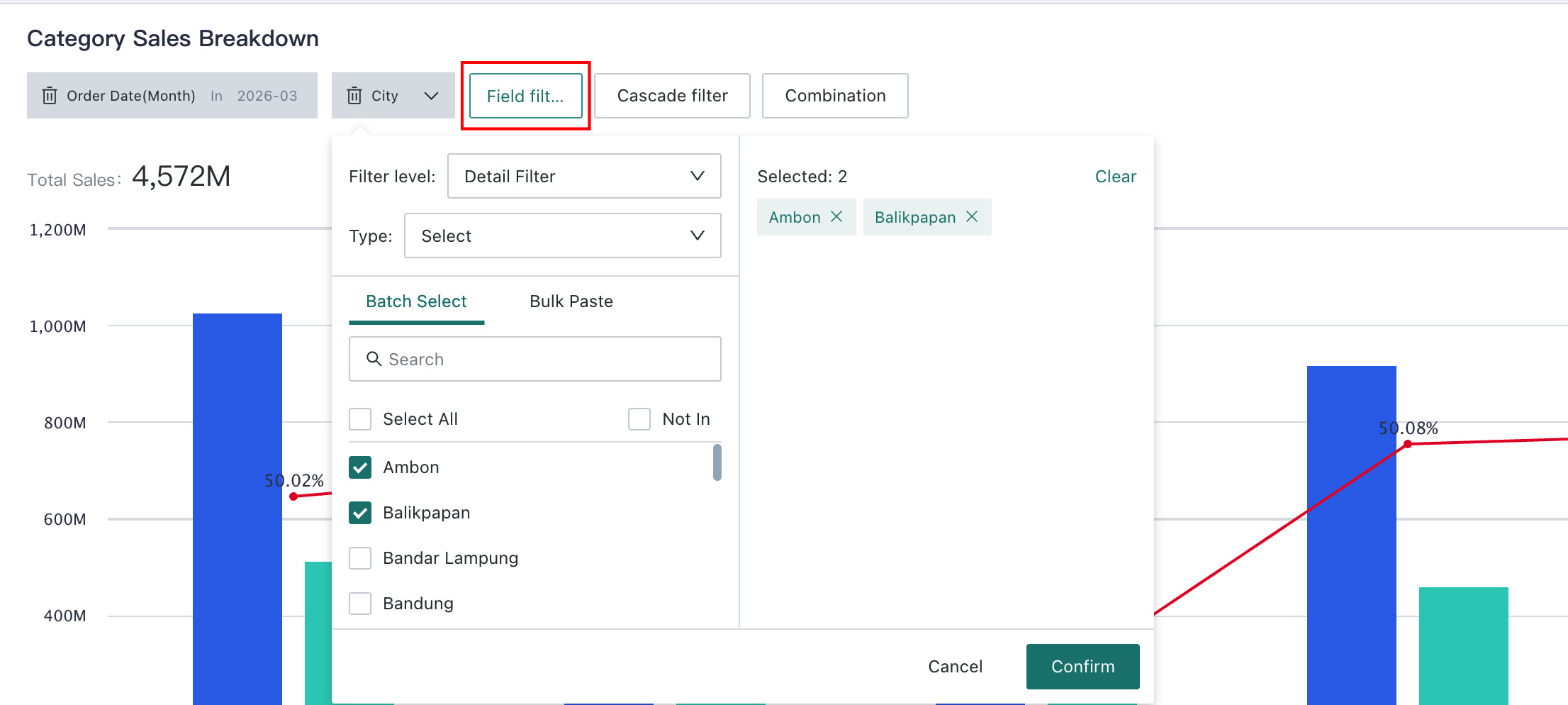
By adding field filter conditions, users can filter data for a single field.
Click "Field Filter", select the dimension and measure fields to be analyzed in the current Dataset, and select the filter conditions needed for the fields.
Cascade Filter
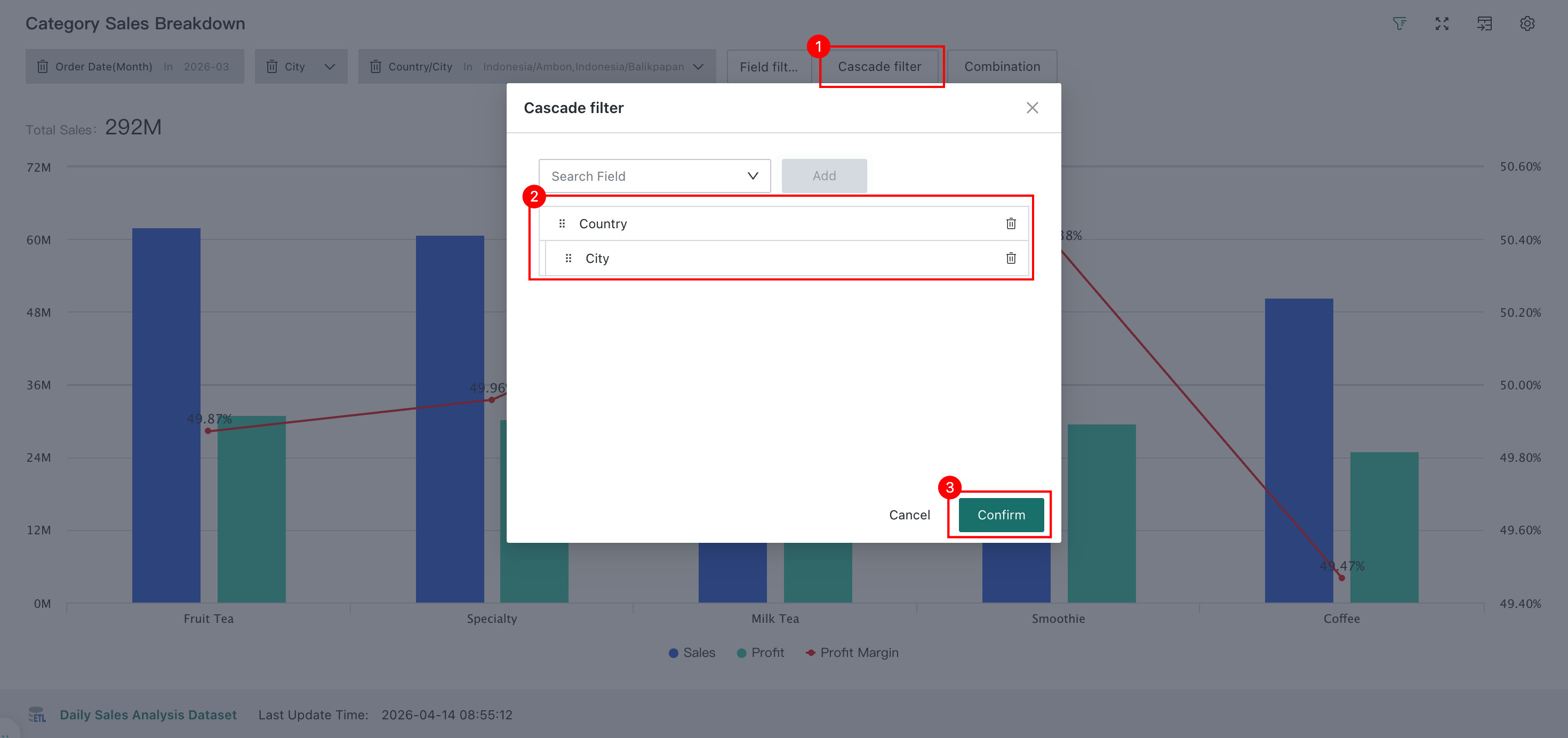
Through cascading filtering, users can simultaneously filter data from multiple fields in combination.
A maximum of 5 fields can be added to a single cascading filter condition.
-
Click "Cascading Filter", select the dimension and measure fields to be analyzed in the current Dataset.
-
Configure the filter conditions for the selected fields.
Combination
By configuring combination filters, users can set "AND" and "OR" logical relationships for filter conditions, enabling more complex filtering.
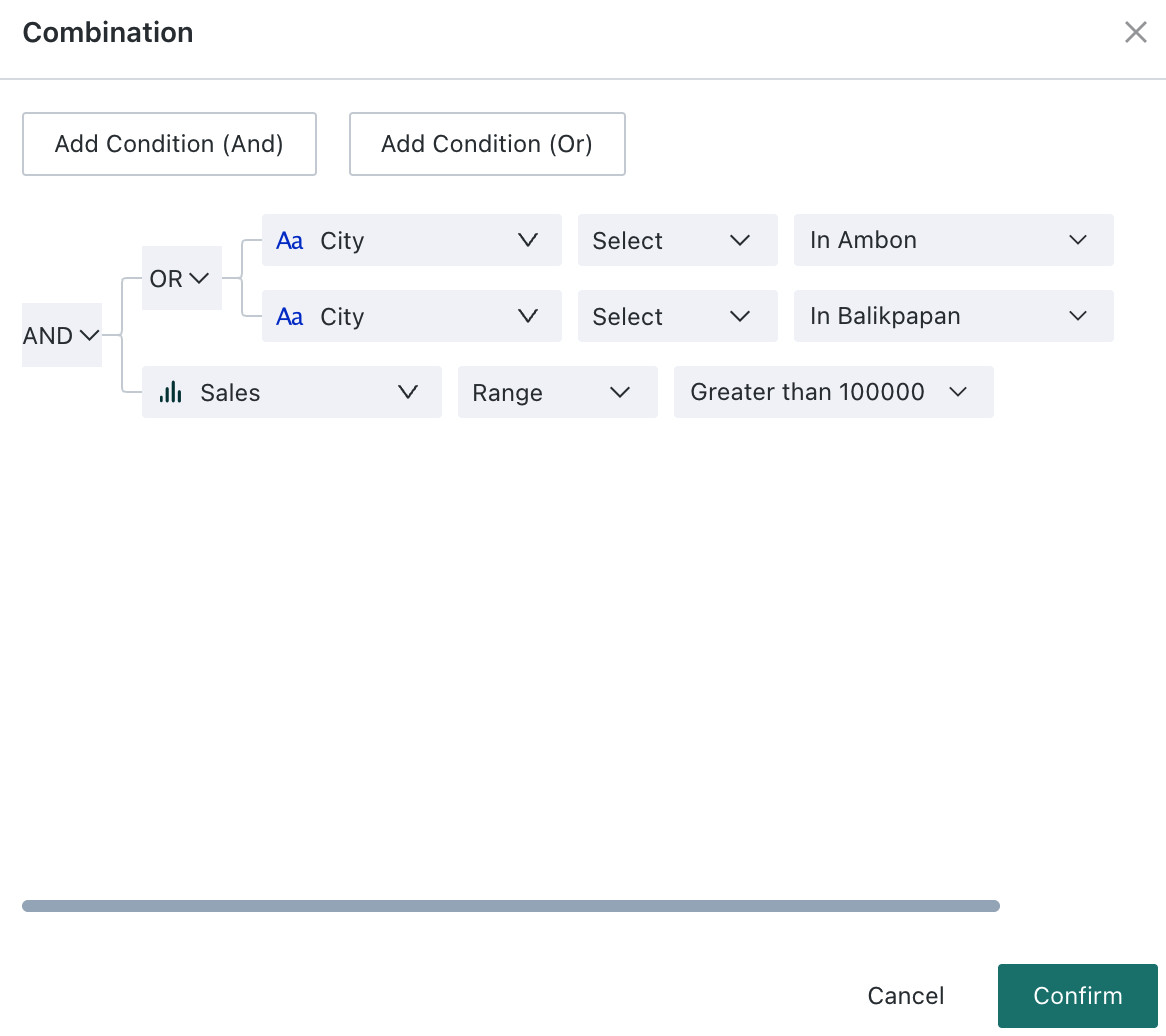
Click "Combination" to configure the filter conditions. For example, in the image below, set the combined condition to products where "Ambon and Balikpapan have sales greater than 100000". Click "Confirm" to complete the Combination filter.