Enterprise Visual
Overview
Enterprise Branding refers to the configuration and management of enterprise Pages, color schemes, and related elements so that the platform aligns with the enterprise's visual brand standards and strengthens internal brand recognition.
Usage Guide
Logo and Appearance
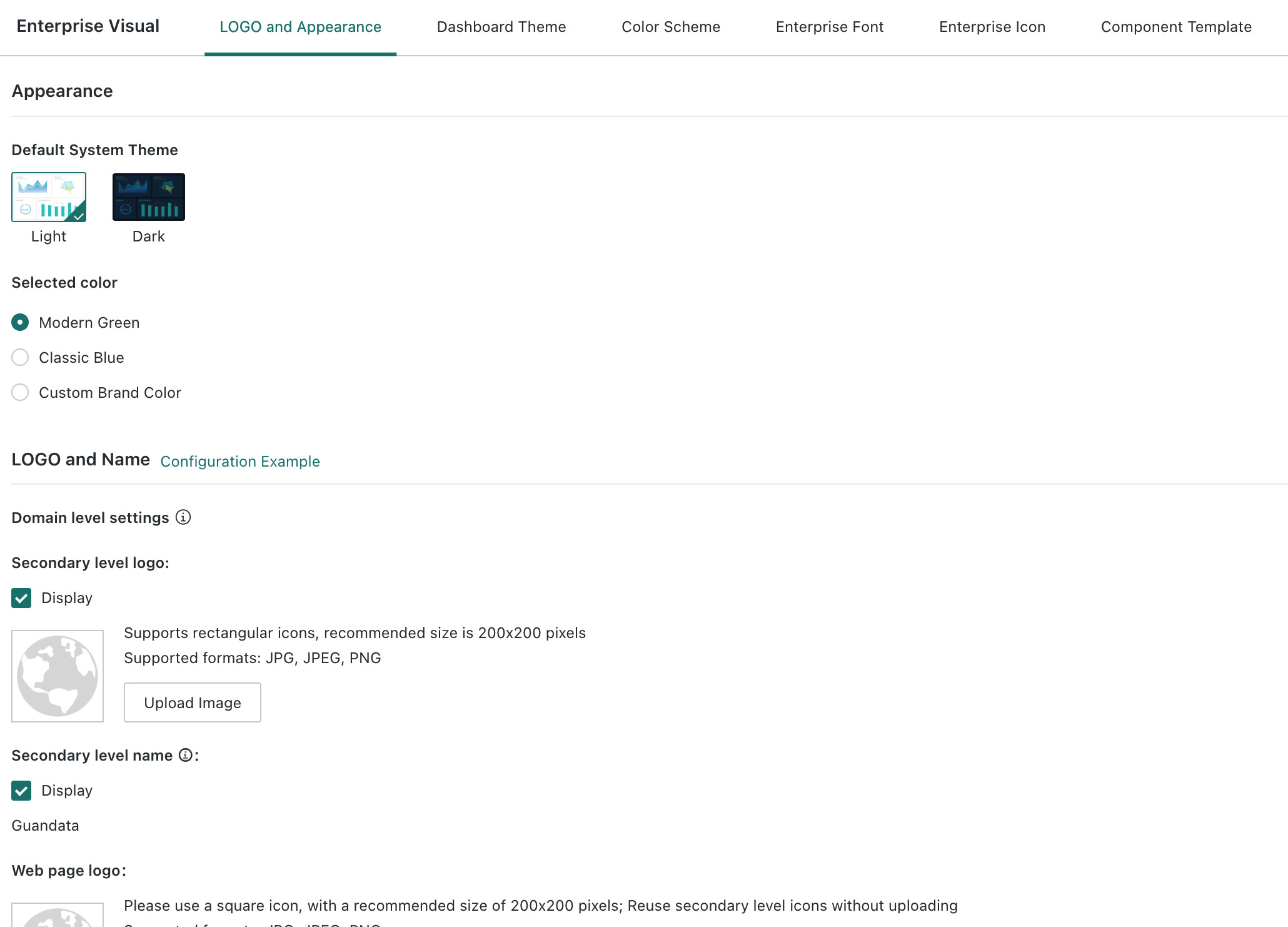
In Enterprise Branding > Logo and Appearance, you can choose the default platform theme and color scheme, upload a favicon, modify the login page Logo and background image, and hide the vendor Logo and label.
- Changes to the login icon require a forced refresh. Other modifications take effect immediately after they are saved.
- Self-service modification requires the L1008 Login Page Customization license item to be enabled.
In Appearance, you can set the default system theme and color scheme. The default system theme supports Light and Dark; the color scheme supports Modern Green, Classic Blue, and Custom Brand Color. After selecting Custom Brand Color, you can configure the platform's primary color according to enterprise brand standards, keeping interface elements such as navigation, buttons, and selected states consistent with the enterprise visual identity.
Dashboard Themes
Under Dashboard Themes, you can centrally manage theme Resources for Dashboards, including the six built-in Dashboard themes, themes downloaded from the marketplace, and custom themes. For details, see Page Style (Theme).
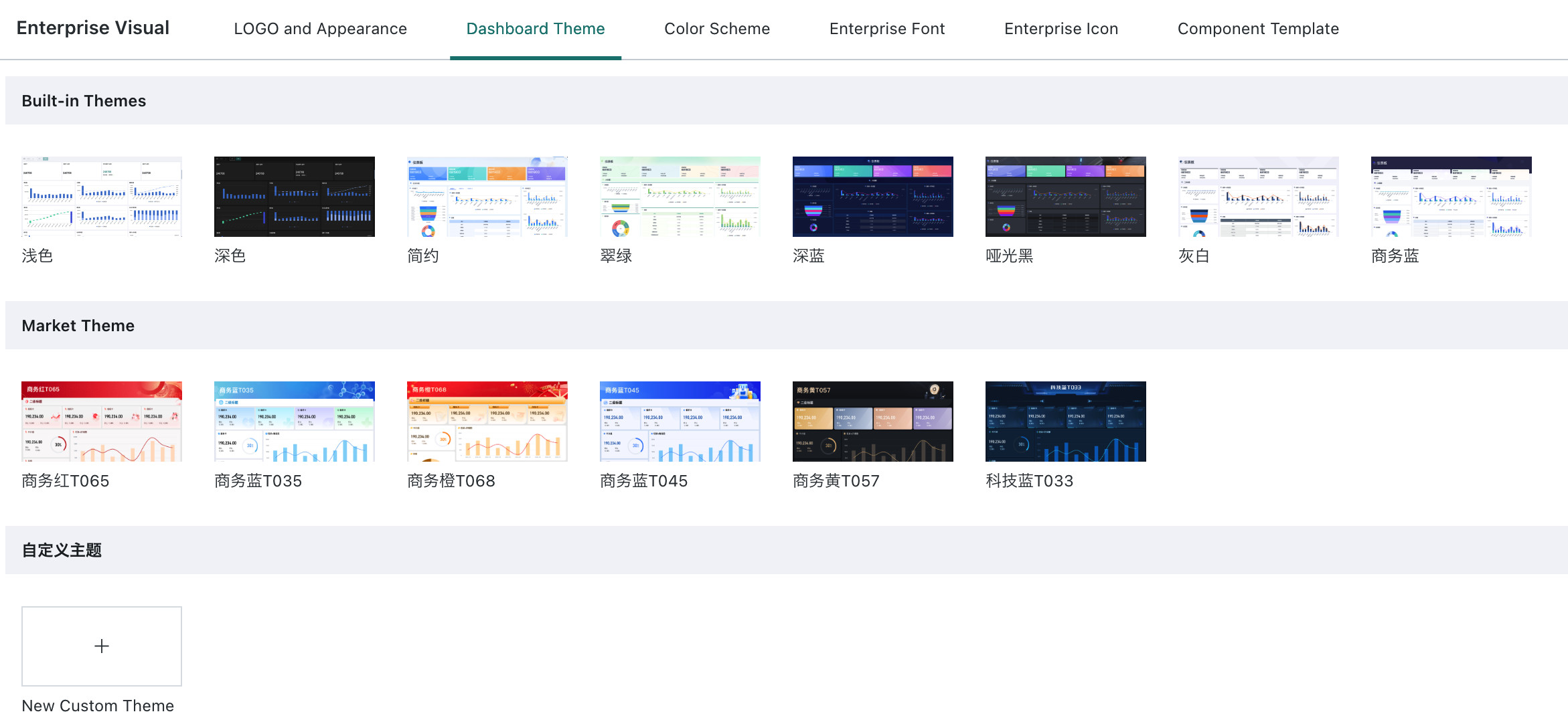
- Built-in themes support preview only.
- Themes downloaded from the marketplace support preview and deletion. Deleting them does not affect Pages that already use the theme.
- Custom themes support creation, editing, and deletion according to enterprise needs.
Color Schemes
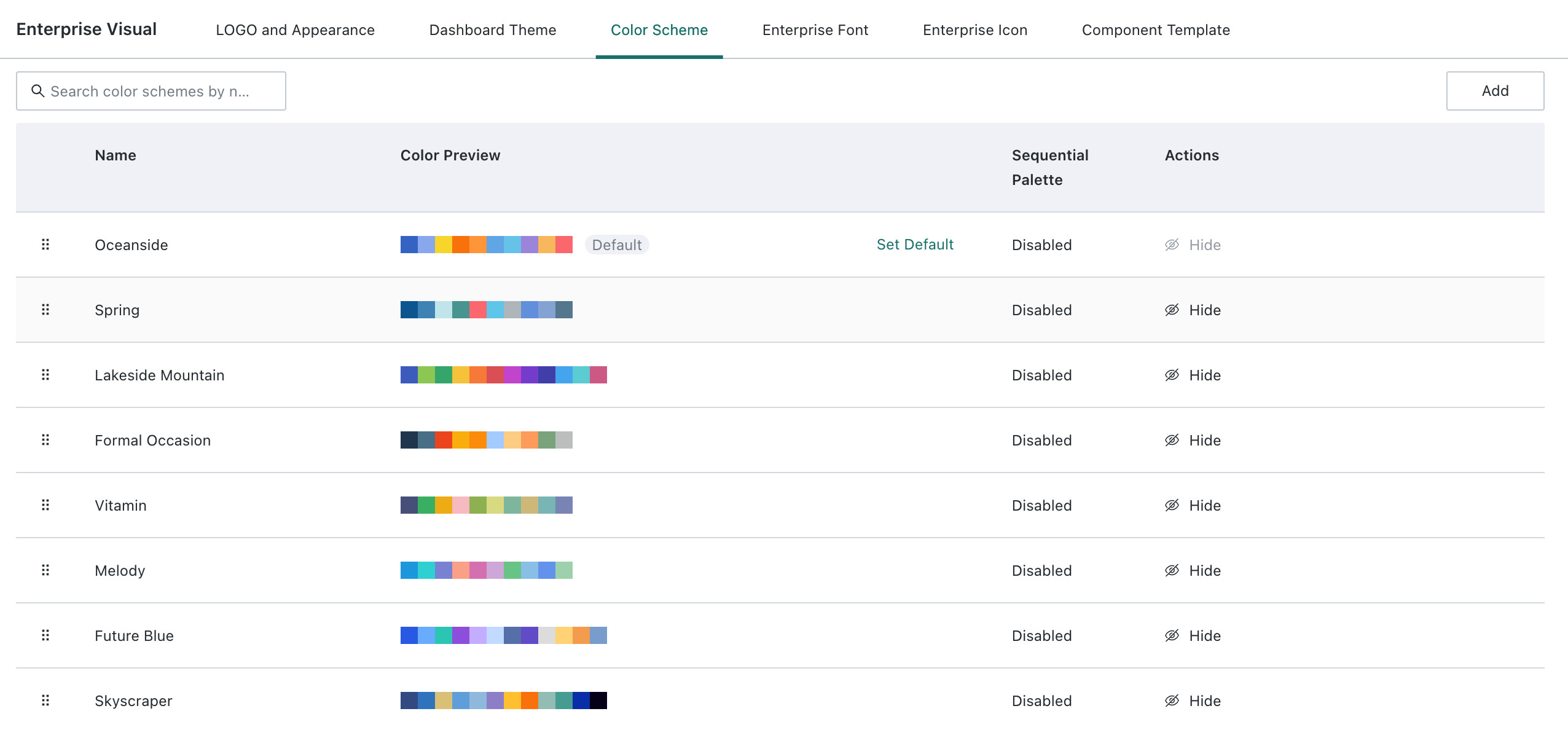
Under Admin Center > Enterprise Configuration > Enterprise Branding > Color Schemes, you can manage color schemes.
-
System-built color schemes: can be selected to hide (display) or set as default.
-
Custom color schemes: can be selected to hide (display), set as default, edit, migrate, or delete.
-
The color scheme list supports searching by color scheme name, making it easy to quickly locate the color scheme that needs management.
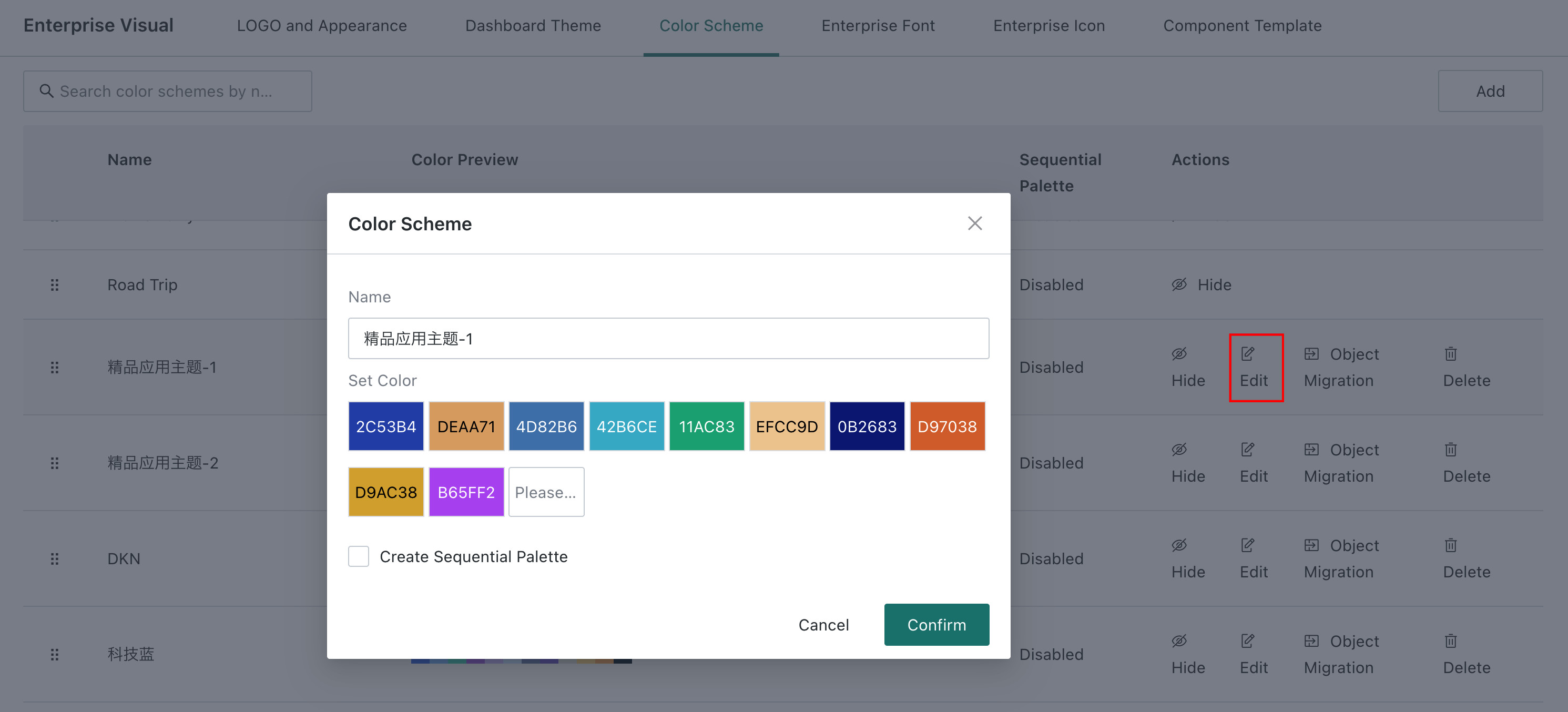
How to customize a color scheme: click the Add button in the upper-right corner, enter the color scheme name, and enter the color HEX value below. Press Enter to finish. Repeat this operation multiple times to enter multiple colors. After all colors are entered, click Confirm to save the custom color scheme.
When creating or editing a color scheme, you can select Create Sequential Palette. Sequential palettes are suitable for data display scenarios with sequential or weighted relationships such as funnels, proportions, levels, and stages. The system automatically generates 10 gradient color values based on one color in the categorical palette.
When creating a sequential palette, you need to select a base color from the configured colors. The system will automatically generate a sequential palette from light to dark or from dark to light based on the base color. Currently, manually modifying individual gradient color values is not supported.
- Historical color schemes and newly added color schemes do not create sequential palettes by default.
- If the base color used by the sequential palette is modified, the system will synchronously update the corresponding sequential palette.
- If the base color used by the sequential palette is deleted, the system will default to the previous color as the new base color and regenerate the sequential palette.
Enterprise Fonts
Under Enterprise Fonts, you can view the fonts in the enterprise domain. You can upload .otf or .ttf files to add fonts, and you can rename or delete existing font styles.

Enterprise Icons
Under Enterprise Icons, you can edit, delete, and hide existing enterprise icons.
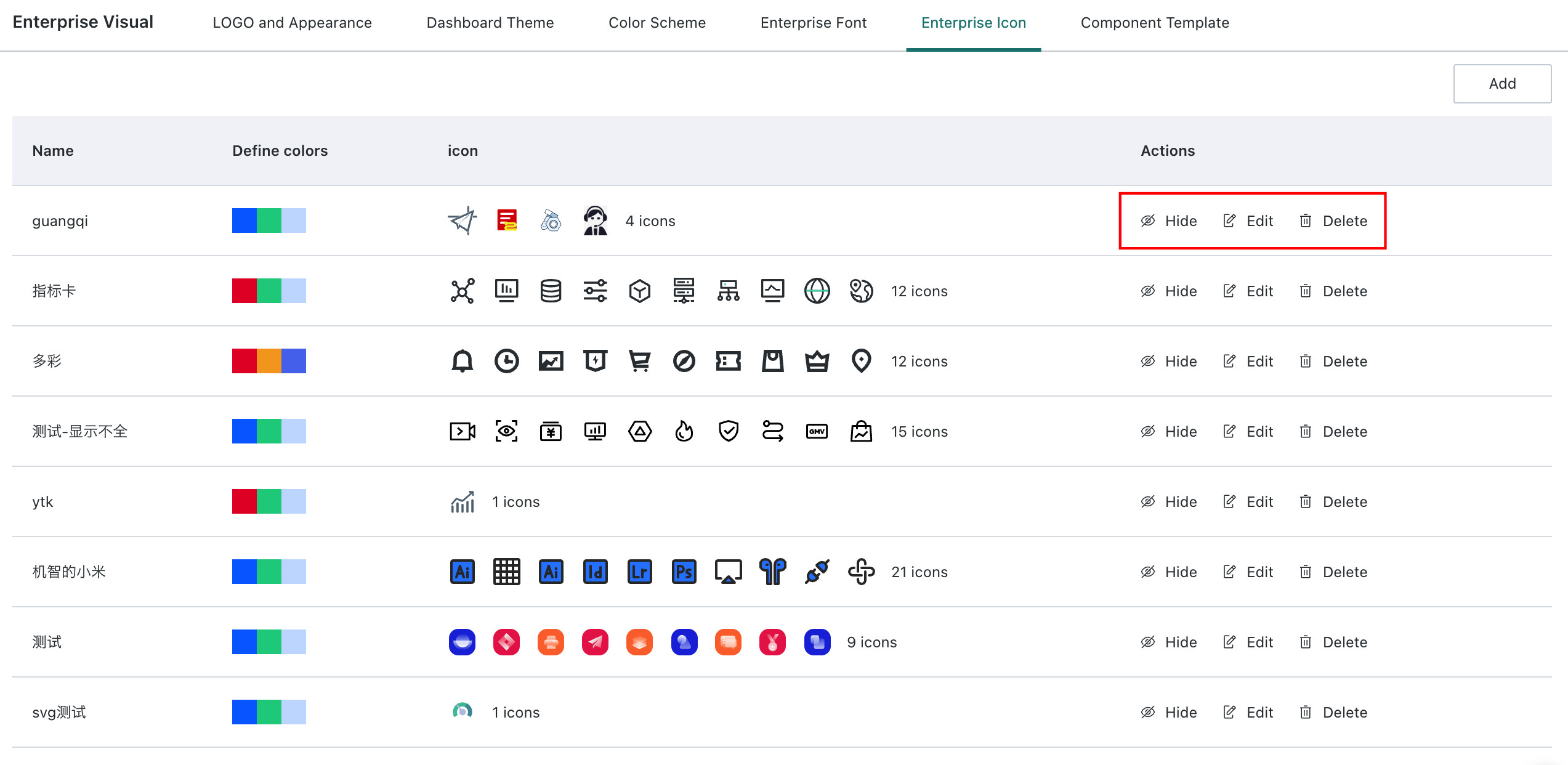
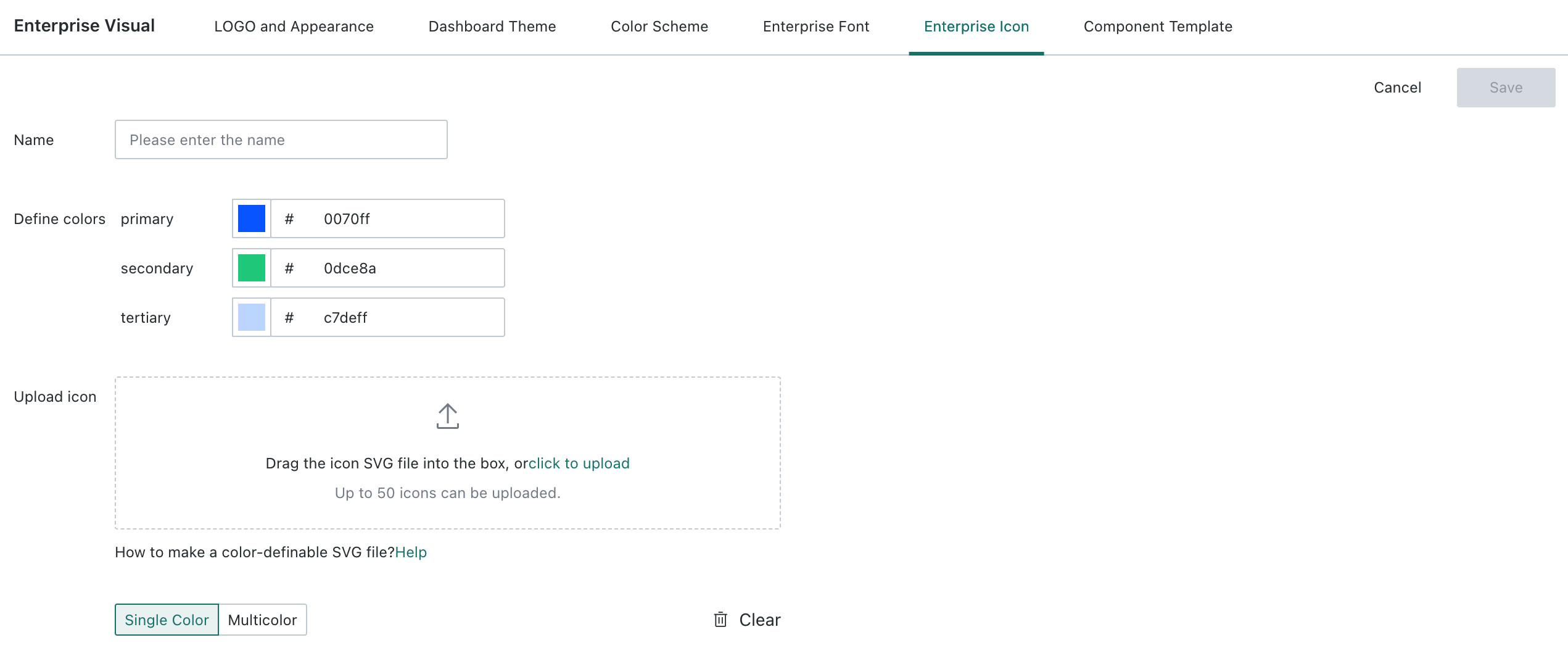
You can also click Add to upload a new enterprise icon, then click Save after completion. For icon design requirements, see Enterprise Icon Design Specifications.
Component Templates
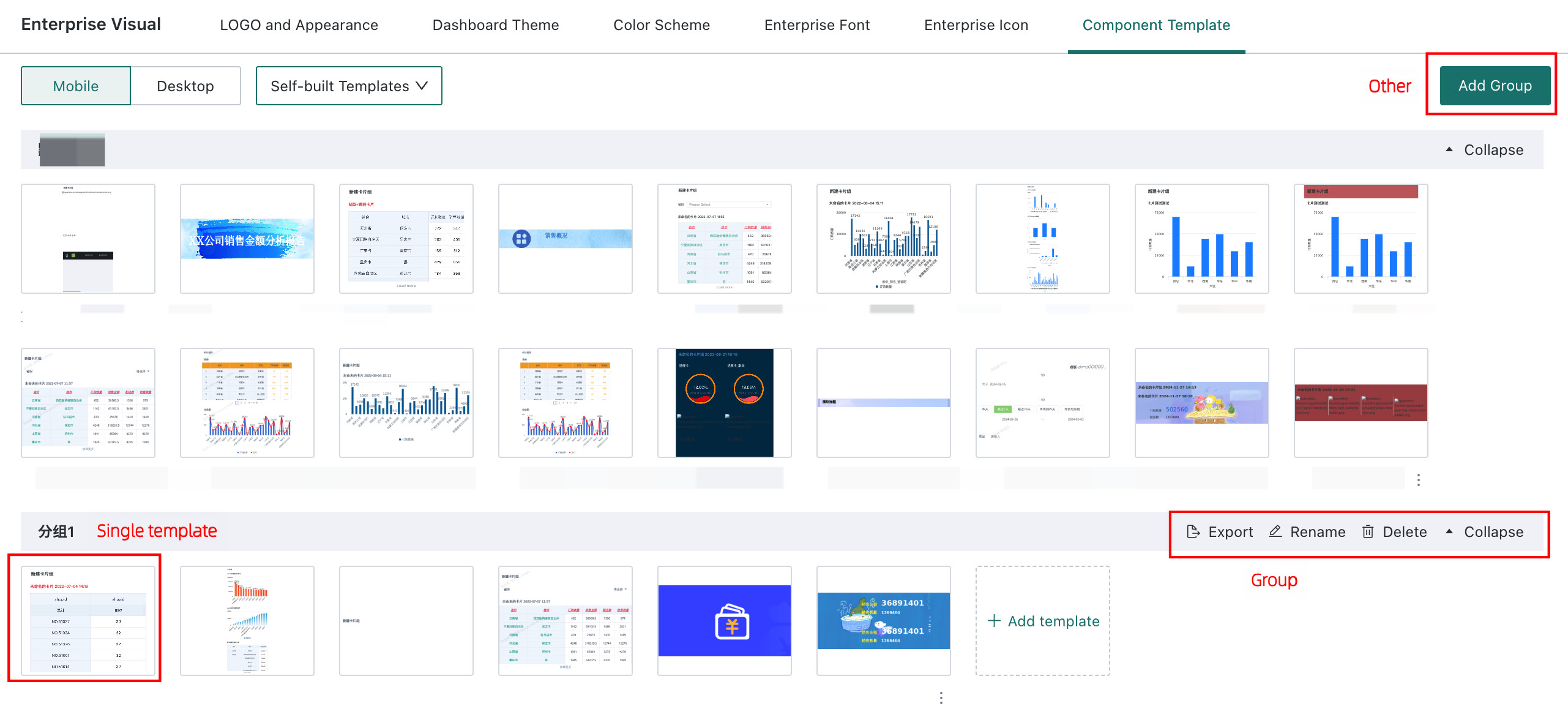
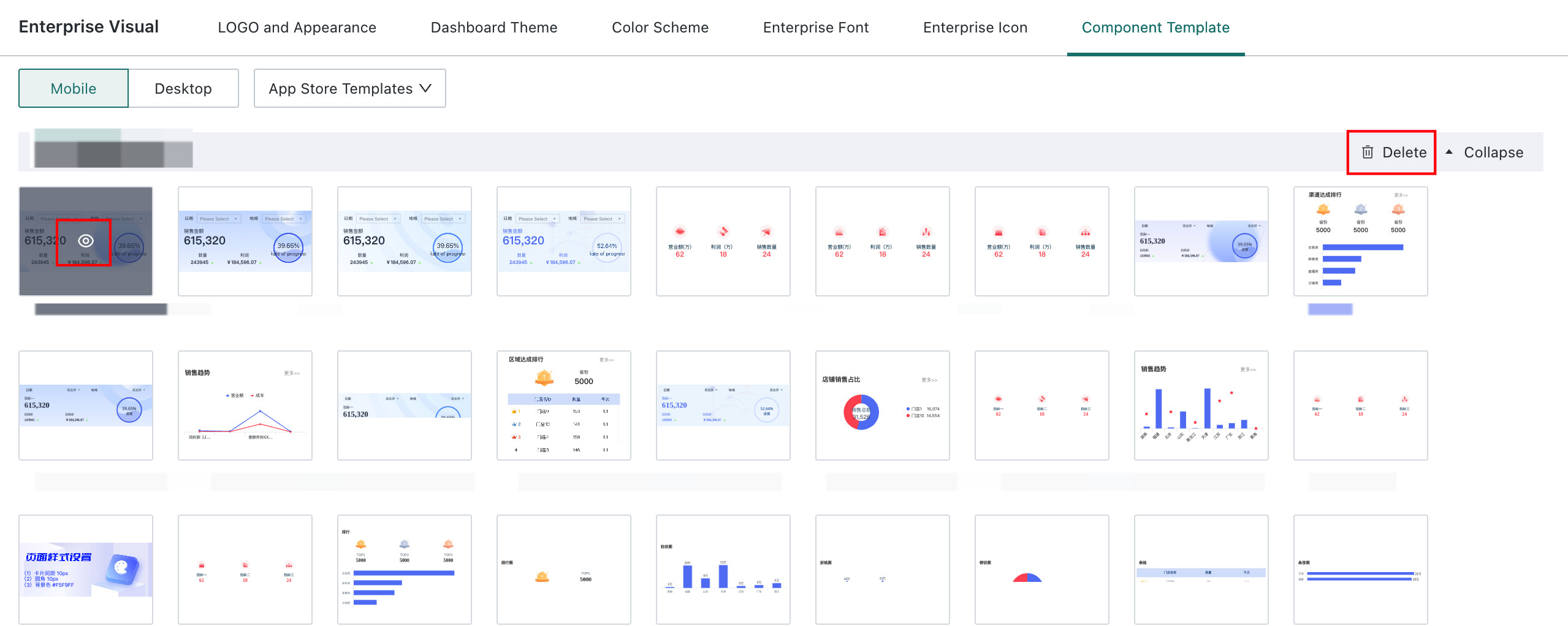
Under Component Templates, you can view and manage self-built templates added to Dashboards and component templates downloaded from the marketplace. For more details, see Component Template.
-
For self-built templates:
- Single template: supports rename, preview, delete, and move to the default group.
- Group: supports rename, delete, and add template.
- Other: supports adding groups.
-
For marketplace templates: supports Preview and Delete Entire Group.
Enterprise Icon Design Specifications
Enterprise icon design specifications define the rules that must be followed when using enterprise icons on the platform.
Enterprise Icon Design Workflow
Set the Icon Size
When drawing icons, the recommended size is 48 × 48 px. Keep the main content within 44 × 44 px, leaving a 2 px bleed margin.
Draw the Icon
When designing icons, layers must be separated in the design software. One to three layers are supported, and they should be named primary, secondary, and tertiary to define paths whose colors can be modified. The icon style may be outline, filled, or a combination of both, but the full icon set should remain consistent in style, stroke weight, corner radius, and perspective.
.png)
Save as SVG
Save the file in SVG format and use an appropriate file name.
Enterprise Icon Design Rules
- Closed shapes: graphics must be closed, and no unclosed shapes are allowed.
.png)
- Nodes: minimize the number of nodes used in the graphic and simplify the shape by removing unnecessary nodes.
.png)
- Merge shapes: if there are two or more shapes, or shapes with Boolean relationships, merge them.
.png)
- Fill color: completed shapes must be filled with the appropriate color. Solid colors are recommended. Gradients are not currently supported.
.png)
- Size: draw the graphic within the defined boundary and try to fully use the drawing area. The actual icon size can be adjusted flexibly.
.png)
- Outline conversion: convert strokes to outlines so they become closed shapes.
.png)