Subscription and Alert FAQ
Can a subscription plan automatically send emails after the data source is updated?
Card subscriptions can run after data updates. Starting from version 5.5, page subscriptions support push triggered by datasets involved in the page, using the same trigger method as ETL. Merged subscriptions do not currently support push after data updates. Dataset subscriptions support pushing to an FTP server after data updates, but do not support email push.
Can time macros be displayed correctly in alert names?
Alert names do not support time macros. Write time macros in the alert notification title or notification content. The alert name is used only for alert management and is not displayed in pushed messages. Notification titles and body content support time macros.
How do I set filter conditions for a subscription, such as sending data from the last 7 days?
The subscription itself cannot set filter conditions. Filter the last 7 days inside the card, and then create the subscription.
Do row and column permissions take effect for combined reports?
Yes.
When creating an alert, how do I trigger it when a field is greater than a specific value?
Create a rule, select the field, choose Range as the type, and then enter the value.
How do I add a card alert in Alert Center?
Create card alerts directly from the card menu. Dataset alerts are added in Alert Center.
When creating a card alert, why are quick dates such as "Yesterday" unavailable in the range?
If the dimension is a split date field, such as Time [Day], quick dates are unavailable. Quick dates can be selected only when a date or timestamp field is placed in the dimension area without being split.
How do I solve the issue where the same card is split across two pages when exporting a page to PDF?
Set the export view to single page. If the export view is paginated, adjust the position and size of each card to ensure the same card stays on one page.
Does Guandata support sending subscription emails to email addresses that are not Guandata accounts?
Starting from version 7.0, subscriptions and alerts can be sent to external email addresses. Enable Allow sending to users outside the system in Management Center.
Do read-only users have no export feature?
Read-only users can export only if: 1) the read-only user role has export permission enabled; 2) the read-only user has export permission for the resource. For details, see Resource Export Permission Configuration.
What is the difference between exporting a card as Excel/CSV and exporting a data table?
Exporting Excel or CSV exports a data table without rendered formatting. Exporting a data table keeps the table format exactly the same as what is shown on the dashboard.
Is the content of an Excel attachment for a subscribed card not restricted by card filters?
The Excel attachment for a subscribed card is restricted only by filters inside the card, not by page filters.
Are subscription push attachments based on the full dataset? Can each recipient receive only data within their visible scope?
Subscription attachment permissions follow the creator's permissions, not the recipient's permissions. Starting from version 5.8, Guandata BI supports conditional distribution for subscriptions. You can manually add distribution conditions, with up to 10 conditions by default, to push different data to each recipient.
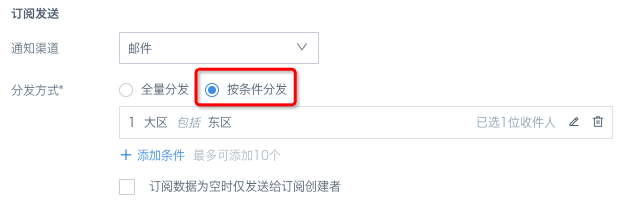
A dataset has two email fields. When creating a dataset alert, all recipient distribution conditions are selected. The alert shows triggered, but no email is received. Why?
Duplicate matching is not currently supported. If duplicate matching occurs, the recipient cannot be found.
Why does subscription push fail with Export PAGE FAILED/Invalid argument /null/Unknow Error?
Common causes: 1) the subscription creator lost permission for the subscribed resource; 2) the subscription creator's account was disabled or deleted; 3) recipient information, such as email or DingTalk ID, is incomplete.
Solution: Ensure that the subscription creator can open and manually export this resource normally. Alternatively, delete the original subscription and have the new owner recreate it.
Email subscription sending fails with "send email failed due to invalid email address:", but some recipients receive multiple subscriptions
Cause analysis: One recipient in the subscription has an invalid address. This triggers the subscription failure mechanism, and the entire subscription is resent. By default, it retries every 15 minutes after failure, for a total of 3 retries. Therefore, recipients with valid addresses may receive multiple emails. In addition, automatic retries after this sending failure are not displayed in sending history, so only one failed subscription record appears. Sending history displays scheduled sends and manual sends configured by users.
Solution: 1. Remove the recipient with the invalid email address, or modify the email address. The subscription will then send normally. 2. The failure mechanism is a configuration item. Contact relevant staff, such as your dedicated consultant or after-sales support, to check whether the environment has the failure mechanism configured and adjust it as needed. If you do not want recipients to receive repeated sends, disable the mechanism. If you want only one retry, contact Guandata and set the failure retry count to 1 in the configuration item.
Formulas in the template are lost after a combined report is downloaded
Cause analysis: To ensure combined report export efficiency, before combined report data is written into the Excel template, all rows below the selected row count are cleared. Otherwise, importing must check existing data rows one by one, which is inefficient. Therefore, retaining original data in the template is not supported.
Solution: First create the original table framework in sheet1 of the Excel template, with its data referencing sheet2. Then import card data into sheet2. This still allows all data to be viewed in one sheet.
Additional introduction to combined reports
For scenarios where data from multiple cards must be exported into the same file in a specified format for download or distribution, the Guandata platform provides the combined report feature.
Steps:
- Find the combined report feature in the nine-grid menu and configure the combined report as needed.
- Usually, a combined report consists of one template file and several cards. You can specify the corresponding data write position for each card. If the template file also contains headers or data formats, the system intelligently applies these headers or data formats in the final output file.
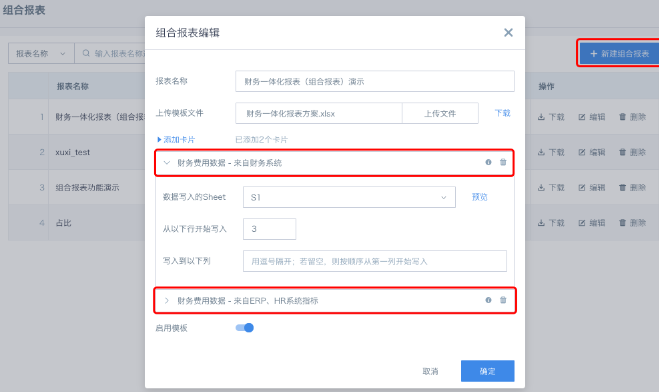
The number of cards that can be added depends on the number of sheets in the uploaded Excel template. One card can write to only one sheet. Therefore, the number of added cards cannot exceed the number of sheets in the uploaded Excel template.
Data in the subscribed table card attachment is incomplete
Cause analysis: The subscribed object is a table card, and it exports table data. The export limit for table data can be configured.
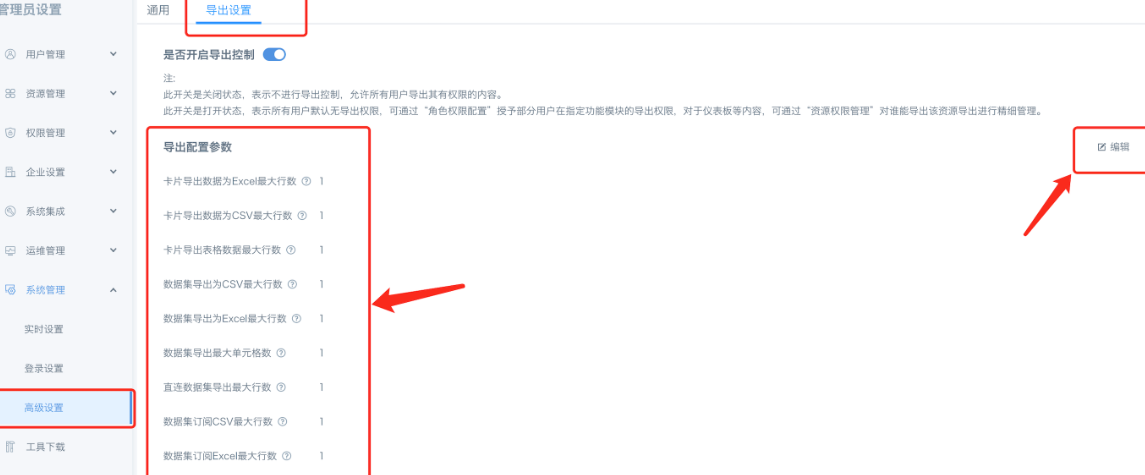
Solution: Go to Admin Settings - System Management - Advanced Settings - Export Settings, and click Edit on the right to modify export configuration parameters. Do not set Maximum Rows too high, because export consumes performance.
Attachments for table cards are table data. Attachments for charts are Excel files.
How do I customize alert time granularity?
- The dataset must have a field that determines whether the data meets the alert time granularity. For example, if you want an alert every 6 hours, the dataset must have a field that determines whether the data belongs to the latest 6 hours. If not, create one, such as unix_timestamp((max([latest time in the data or time field to be judged])over(partition by null))).
Note: For direct datasets, use the corresponding database functions.
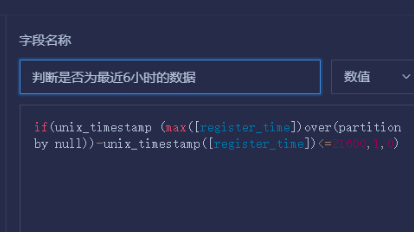
- Set the alert and use the newly created field as one of the conditions.
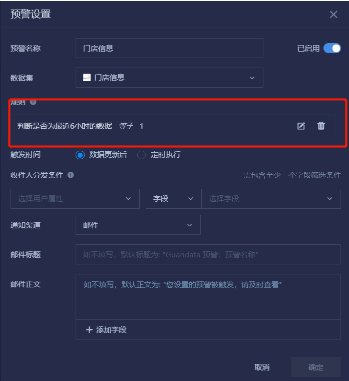
Note: This example uses a dataset alert. For a card alert, drag the newly created field into the card and use it before it can be configured as a condition.
BI cannot recognize timestamps uploaded from Excel
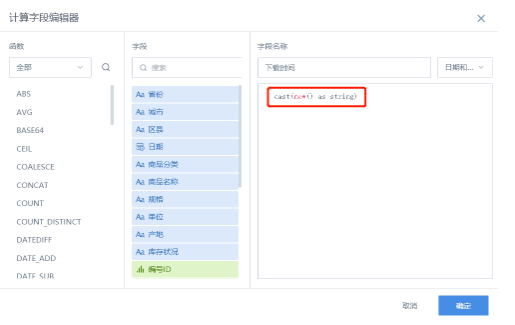
- Add a Download Time column to the table for download, and set the content of this column to cast(now() as string). The download time is stored in Excel as text, avoiding the issue where timestamps display only as dates after Excel is downloaded:
-
Create a new table with the same header as the Excel file downloaded in Step 1. Use sample data if possible, so you can control the field storage format. Set the format of the Download Time field to TIMESTAMP.
-
When appending data to the table, BI correctly parses the text-format timestamp as TIMESTAMP.
How do I batch export card data with filter conditions?
Prerequisite: The filter must be the Select type.
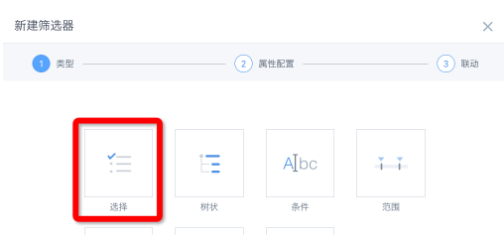
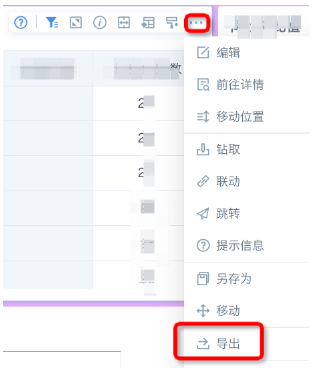
Solution: 1. Select Export in the upper-right corner of the card. If this button is unavailable, contact a user with administrator permissions.
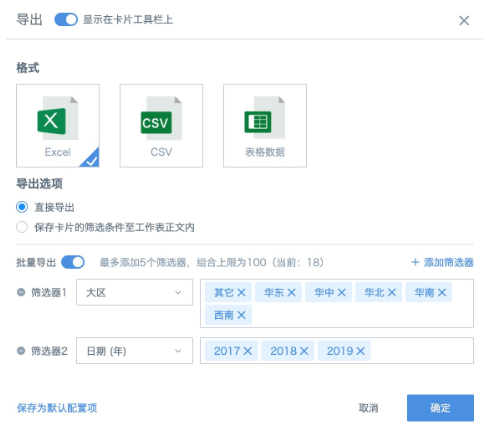
- In the pop-up dialog, enable Batch Export and click + Add Filter. You can add up to 5 filters. You can click Save as Default Configuration in the lower-left corner to save the current configuration for future exports. In the following example, 2 filters are added. Filter 1 selects 6 options, and Filter 2 selects 3 options. The final number of exported Excel files is 6*3=18, meaning data for each region and each year is exported as a separate file. The combination limit is 100, so a maximum of 100 files can be exported at one time.
- Click OK to save. The page displays a task start prompt. After completion, a notification appears in the upper-right corner of the BI page. Expand the notification, copy the full download link, and paste it into a new browser window to download and save the file. After downloading, decompress the archive. The archive is named as: card name + export method + export time. Each file is named as: card name + filter condition.
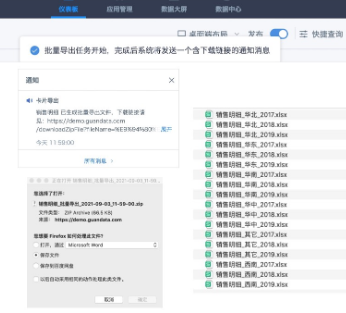
1). Exporting Excel or CSV exports only the data in the chart, without any rendered formatting. Batch export of formatted table data from table-type cards is not currently supported.
2). The exported data volume is limited by the row count. Setting path: Admin Settings - System Management - Advanced Settings - Export Settings.
3). The system automatically compresses all exported files into one ZIP archive. If the filter option combinations produce too much data, perform batch export multiple times.
4). For the same card, the next export task can start only after the current export is complete.
When exporting PDF, data is incomplete and the table is too wide to display on one page
If the exported page PDF is incomplete, the page may contain tabs with scrollbars. In this case, drag the tab scrollbar until it disappears so the content can be displayed completely.
- Adjust column width or reduce the number of columns to reduce the table width.
- Adjust the page export size in the export view:
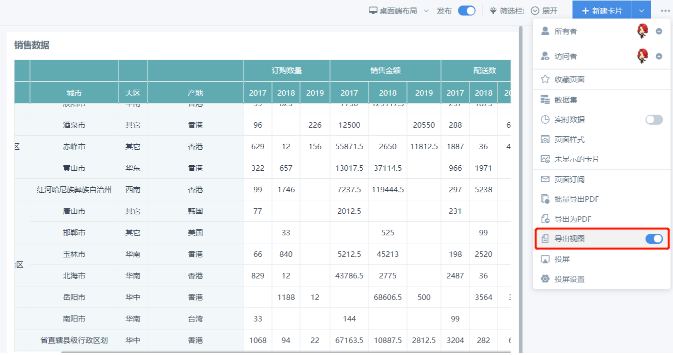
- Export views are divided into single-page and paginated views:
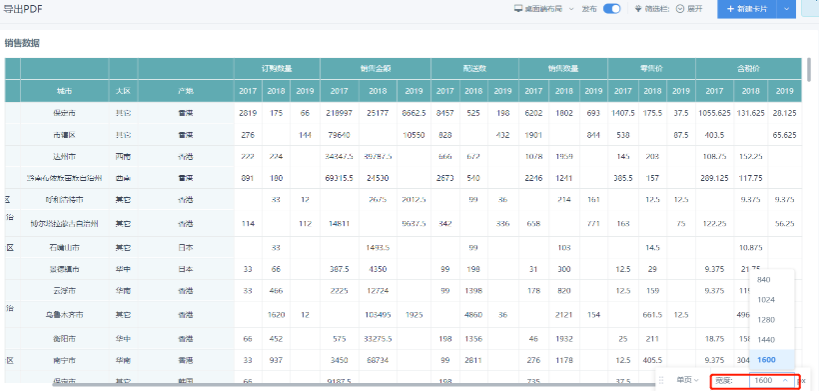
- Single-page allows page width adjustment. The current minimum width is 300 px and the maximum width is 3000 px. You can manually enter a custom width:
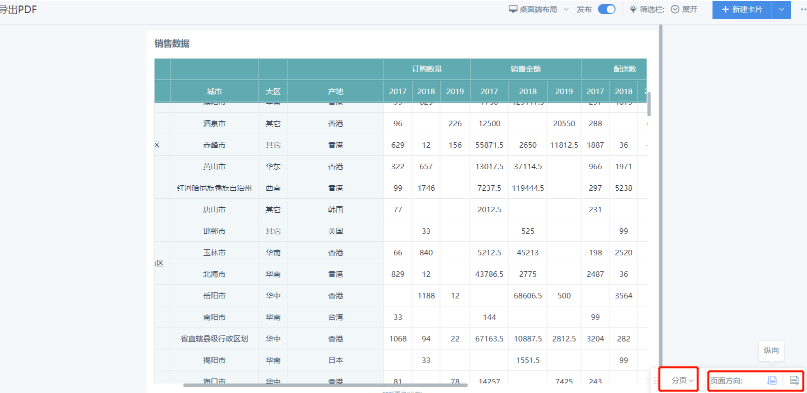
- Paginated allows you to adjust the page orientation to landscape or portrait, but does not allow width adjustment:
The image shown in the page subscription push notification is inconsistent with the desktop dashboard page
When a page subscription selects the page image as Image Content, the pushed page style is consistent with the dashboard page's Export View.
When exporting data from BI, why do both Excel and CSV exports contain only headers?
The error message is "The current data volume exceeds the dataset export limit (1 row or 1 cell)." The cause is that the dataset export limit has been set. Modify this setting to resolve the issue.
Subscription sending fails with attachment out of limit
- Subscriptions currently have different attachment size limits for different channels. The default is 50 MB for email, 20 MB for DingTalk and WeCom, and 30 MB for Feishu. If an attachment exceeding the limit is detected, the subscription fails directly.
- Whether the size can be modified: Currently, third-party application file APIs other than email channels have size limits, and Guandata cannot modify them. For email channels, if the mail server itself supports larger attachments, you can modify the underlying configuration parameter
email.attachmentMaxSizeto change the attachment size limit on the Guandata side.