Item View Usage and Case Sharing
Requirement Background
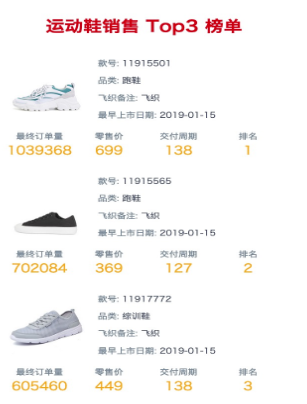
This visualization is similar to a card or business card and is used to display product introduction information with images, sales volume, and other metrics. Applicable scenarios include Top product rankings by sales during promotions, popularity rankings in competitions, or ranking lists.
Prerequisites
The dataset needs one field dedicated to storing image path links, in text format, and another field storing the unique identifier corresponding to each image, such as a detailed name or code. These two fields form a mapping relationship. Therefore, images must be uploaded in advance to a fixed online storage space and be directly accessible through links.
Usage
- Create a card and select Item View from Other Types, or search Item View directly.
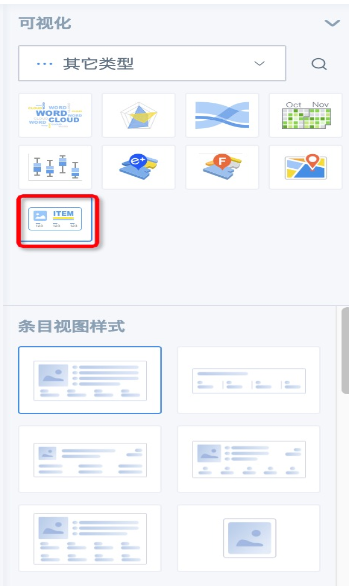
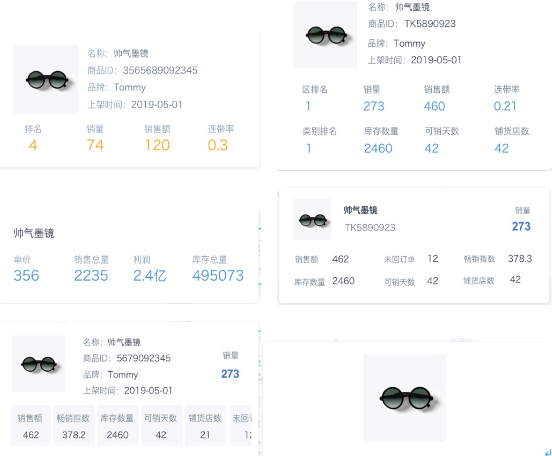
2. There are six styles. Five require images and one does not. Hover over a style to preview its effect. Each style is fixed and the layout cannot be adjusted, so choose one based on your needs.
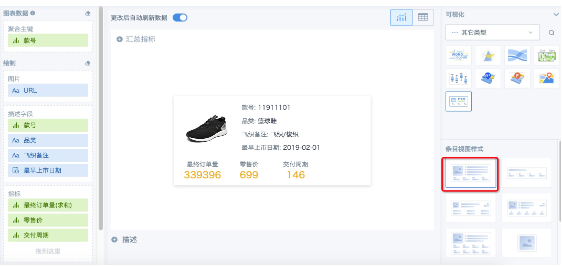
3. Drag the image link field into Image, drag the unique identifier field corresponding to the image into Aggregation Primary Key, and drag fields that need to be displayed horizontally on the right side of the image into Description Fields. You can click a field to set aggregation method, data format, and rename it. Value fields can also use advanced calculations. Drag value fields that need to be arranged vertically below the image into Metrics, and configure aggregation method, default Sum, advanced calculation, data format, and renaming as needed. Card format can be configured on the right side of the page.
4. Because an item view card can display only one image plus related descriptions and metrics, it is equivalent to having only one row of data after aggregation. Therefore, filter conditions must be specified: drag a field into the filter area and set filter conditions, or use page filter linkage. If no filter condition exists, the first item after sorting by the aggregation primary key in ascending order is displayed by default.
Case Sharing
Create a Top sales ranking list for a sports shoe brand.\
- Create an item view card, select the first style, drag the Style Number field into Aggregation Primary Key, drag the URL field into Image, drag in four description fields and three metric fields, leaving one empty position for ranking. Set the Final Order Volume field to Sum, and set other fields to No Processing.
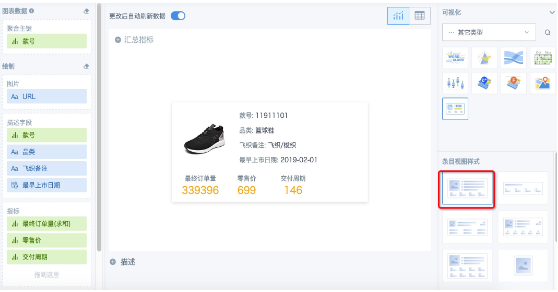
2. Because aggregated value fields in metrics cannot be used for filtering and secondary calculation, create fields to calculate sales volume and sales ranking.
Note: If you use the internal advanced calculation Ranking in the card, the card can display only the first rank and cannot freely select other ranks.
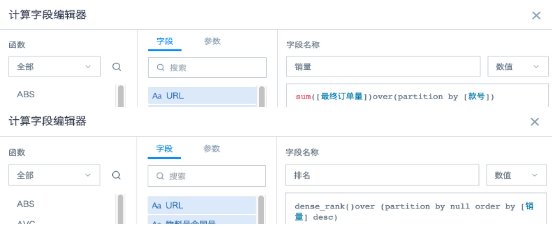
3. Drag the Ranking field into Metrics and set the aggregation method to No Processing. You can see that the card shows rank 7. Then drag the Ranking field into Filter, set the filter range to equal 1 or select 1, and confirm. The card updates and displays the product information for rank 1.
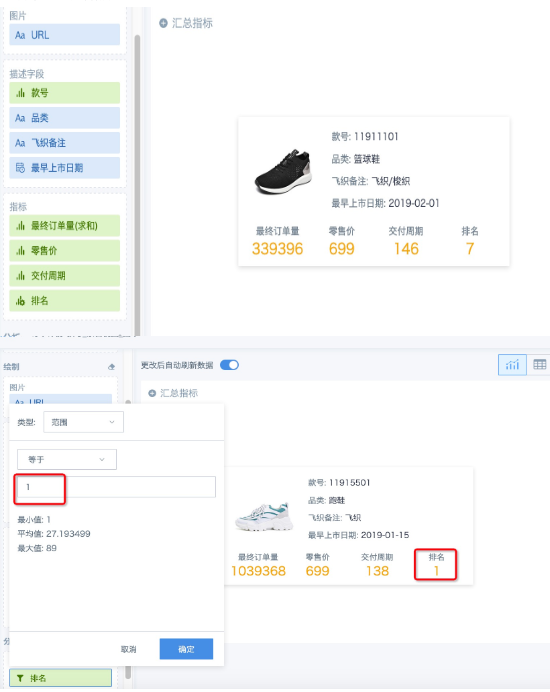
4. Save this card and copy it. In the copied card, change the filter item to 2. Copy the card as many times as the number of ranks needed and modify each filter item.
5. Arrange the layout. If a title is needed, create a text card and place it at the top.